


Communication coaching & team workshops

Let your communication reflect what you’re capable of.

From finding your footing to taking on greater responsibility, develop how you express your ideas, carry yourself and respond to others. Personal coaching and tailored team workshops for the conversations that matter.

MBA, IIM AhmedabadFounder of LEAD

From a dark blue corridor, an oak door stands open onto a sunlit meeting room. Light spills across the floor toward you.

Where people begin

Different starting points. More room to grow.

Find your footing.

You have something to contribute. You want to introduce yourself naturally, explain your thinking and feel more at ease around people whose opinion matters to you. We can work on the practical skills and the patterns that influence how you show up.


Expand your range.

You already have experience. Now you are aiming for greater responsibility, working with new stakeholders or communicating across different countries and teams. The question is not how to become someone else. It is how to bring more range to the person you already are.

A long dark blue wall. At the far end an oak door is barely open, and a thin line of daylight escapes onto the floor.

Beneath the words

Sometimes it is a skill. Sometimes it is what happens before you use it.

You may know what you want to say, yet hesitate around a senior colleague. Or you may speak confidently and still need to understand a new audience. We look at the conversation itself, the assumptions shaping your response, and what the other person needs from you.

Illustrative conversations

Same person. Different context.

The intention, in every room

“Test the change with one team before a wider rollout.”

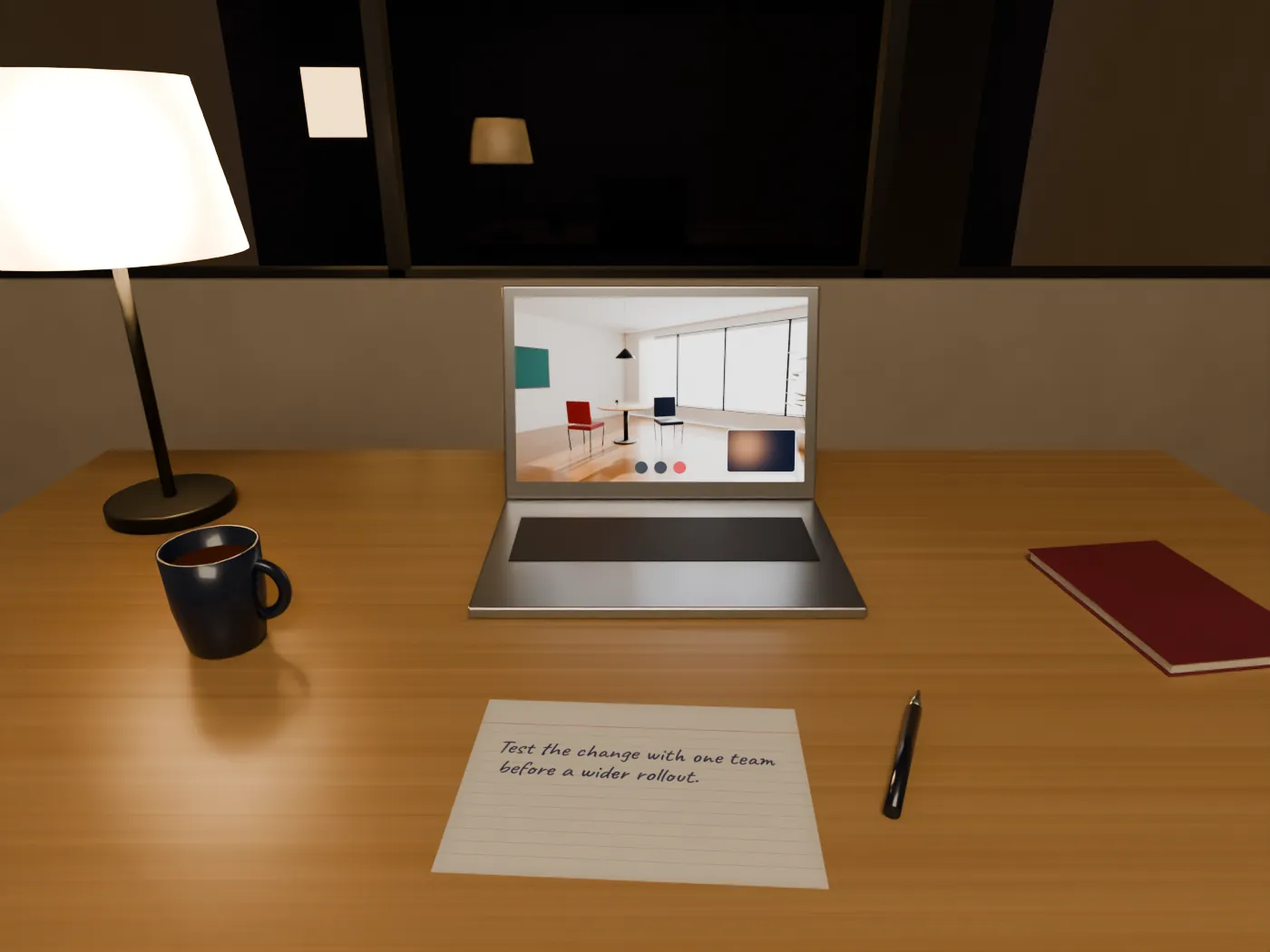
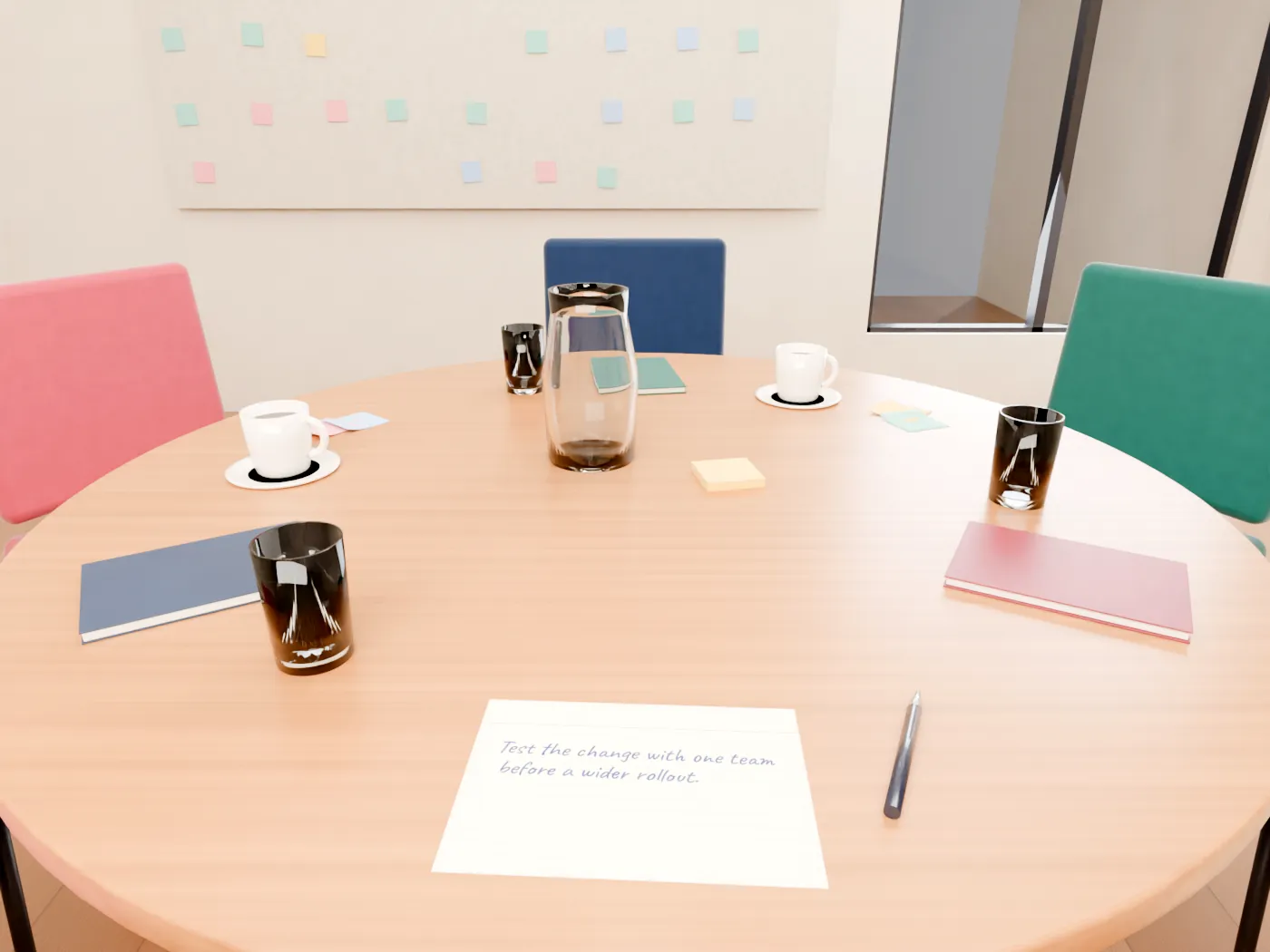
The note on the table stays the same. The relationship across it changes, and so does what the conversation asks of you.

Seen from your seat: a wide walnut desk, an empty high-back leather chair across it, a city window behind. Your handwritten card lies in front of you.
Across the desk
A possible opening
I recommend testing this with one team first. It will help us see what needs changing before we scale.
What to notice
Am I explaining my judgement, or waiting for permission to have one?
A move to practise
State the recommendation and reasoning. Then invite a response.

Your evening desk under a warm lamp, a dark window behind. On the laptop, a video call shows your peer’s sunlit morning room. Your handwritten card lies in front of you.
Across time zones
A possible opening
Before we agree a rollout, what would we need to test for this to work in your team?
What to notice
Are we assuming the same priorities and conditions?
A move to practise
Ask about the context before assuming agreement.

A round table set for six: notebooks, cups and sticky notes at each place, colourful empty chairs, a wall of notes behind. Your handwritten card lies in front of you.
Around the table
A possible opening
Let’s test this with one team first. What might make that harder than it looks?
What to notice
Have I left room for the answer to change my plan?
A move to practise
Invite concerns, listen, and make the next step explicit.

Adapt the approach. Keep your integrity.

Invented teaching examples, not client quotations or a universal script. How a real conversation turns out is never guaranteed.

A long table prepared for a workshop under warm pendant lights: scenario cards, sticky notes, notebooks and a sand timer at the centre, colourful chairs, a pin-board of notes on the far wall.

For companies and teams

Help your team handle the conversations its work depends on.

A team can include excellent individual communicators and still find it difficult to challenge an idea, surface a misunderstanding or reach a clear agreement. Workshops focus on the situations your people need to handle together, with examples drawn from their work.

Discuss a team workshop

Tell me who the team is and which conversations need to work better.

Example focus areas

  1. 01

    Recommendations that help people decide.

    Practise explaining the point, the reasoning and the decision needed, without losing people in unnecessary detail.

  2. 02

    Disagreement without avoidance or escalation.

    Explore how to challenge an idea, ask a difficult question and make space for a useful answer.

  3. 03

    Working across teams and expectations.

    Notice assumptions, clarify meaning and adapt to the people involved, without relying on stereotypes about nationality or personality.

How we shape the work

We agree the situations and intended outcomes before choosing a format. A workshop can combine brief explanation, realistic scenarios, practice, feedback and another attempt. A focused session, a workshop series or a combination with individual coaching can then be discussed around the need.

  1. Brief explanation
  2. Realistic scenario
  3. Practice
  4. Feedback
  5. Another attempt
A possible rhythm, agreed around your team’s situations

What participants can take back to work

A clearer way to handle a relevant conversation, a specific point to practise and shared habits the team can test in its meetings. We can agree observable goals, such as clearer recommendations, better clarification of disagreement or more explicit next steps.

Team workshops focus on work situations and shared practice. They do not require participants to disclose private personal history.

Start with the situations your team actually handles.

Discuss a team workshop

Tell me who the team is and which conversations need to work better.

Not the person who arranges training?

Pass it on with a short note. It copies to your clipboard, ready for email, Teams or Slack.

Email it
See the note

I came across Abhisek Kishor’s communication workshops for teams. They’re built around the situations a team actually handles, like recommendations, disagreement and working across teams, with practice built in. Could this be useful for us? https://abhisekkishor.com/coaching/communication/#team-workshops

For you, or a colleague you support

Work on the conversation. Understand what you bring into it.

We start with something real: a meeting with senior colleagues, a new role, an important presentation or an interaction that did not go as you hoped.

Sometimes the useful work is practical: organising your thoughts, explaining an idea or rehearsing a different response. Sometimes we also explore how you see yourself, what you assume about the other person and why a familiar reaction keeps appearing. The depth follows what is relevant to your goal, not a predetermined story about what is wrong.

Discuss individual coaching

Self-funded or company-sponsored. With a sponsor, we agree the goals and what, if anything, is shared before we begin.

  1. 1Bring a real situation
  2. 2Explore what is happening
  3. 3Try a different approach
  4. 4Use it outside the session, then review what you learn

Practice may involve

  • Preparing and rehearsing a conversation
  • Role-playing another perspective
  • Working on voice and pacing
  • Examining a recurring assumption
  • Reviewing an interaction afterwards

We choose the work around the need.

Examples from individual coaching

“He taught me that self-confidence is the most powerful asset in communication, and that it comes from preparation.”

Lorenzo MecacciStrategy Consultant, AccentureSource: LEAD · Communication coaching

The two accounts are anonymised descriptions of real work, written by Abhisek. They are not client quotations.

Situations we can work on

  • Contributing in meetings
  • Introducing yourself and your work
  • Speaking with senior colleagues
  • Preparing for greater responsibility
  • Communicating across teams and contexts
  • Handling disagreement
  • Presentations and public speaking

For work centred on wider leadership decisions and responsibilities, explore Executive Coaching

Questions

Before we talk.

Is this only for people who lack confidence?

No. You may want to feel more comfortable expressing yourself, or already be a capable communicator preparing for a different level of responsibility. The work starts with what you want to develop.

Is this public-speaking training?

Public speaking and presentation preparation can be part of it. The wider focus includes everyday interaction, self-presentation, listening, senior conversations and adapting to different people and situations.

Can my company arrange coaching for me or a colleague?

Yes. Individual coaching can be company-sponsored, and team workshops can be commissioned directly. At the outset, we agree the goals and clarify what, if anything, will be shared with the sponsor.

How personal does the work get?

Individual coaching can explore personal patterns when that is relevant and you are comfortable doing so. There is no expectation of sharing your private history. Team workshops stay centred on work situations and practical learning.

What about written communication or Business English?

This offer focuses on spoken and interpersonal communication. Written material can be considered when relevant to a situation, but it is not the main service. For language learning and Business English, LEAD offers a separate route.

Inside the meeting room at sunset: two chairs drawn up to a small round table, glasses of water and a notebook, warm light across the floor.

What would you like to handle differently?

Bring a conversation, a role you are growing into, or a situation your team needs to manage better. We can start there.

Start with a free 30-minute introductory conversation.